
English spelling can be tricky, even for English speakers! That’s because English is not 100% phonetic and also because there are so many exceptions. Study the 240 most commonly misspelled words below. Then, try the free spelling test at the end to check how well you’re doing.

While
some words admit multiple spellings, some are not considered standard,
and thus are misspellings. A misspelled word can be a series of letters
that represents no correctly spelled word of the same language at all or a correct
spelling of another word. Misspellings of the latter type can easily
make their way into printed material because they are not caught by
simple computerized spell checkers.
Misspellings may be due to either typing errors, or lack of knowledge of the correct spelling. Whether or not a word is misspelled may depend on context, as is the case with American / British English distinctions. Misspelling can also be a matter of opinion when variant spellings are accepted by some and not by others.
Incorrect: acommodation
Correct: accommodation
Incorrect: acheive
Correct: achieve
Incorrect: accross
Correct: across
Incorrect: adress
Correct: address
Incorrect: appearence
Correct: appearance
Incorrect: assasination
Correct: assassination
Incorrect: beggining
Correct: beginning
Incorrect: buisness
Correct: business
Incorrect: collegue
Correct: colleague
Incorrect: commitee
Correct: committee
Incorrect: concious
Correct: conscious
Incorrect: copywrite
Correct: copyright
Incorrect: dependance
Correct: dependence
Incorrect: desireable
Correct: desirable
Incorrect: embarass
Correct: embarrass
Incorrect: enviroment
Correct: environment
Incorrect: Febuary
Correct: February
Incorrect: fourty
Correct: forty
Incorrect: glamourous
Correct: glamorous
Incorrect: independance
Correct: independence
Incorrect: interupt
Correct: interrupt
Incorrect: intresting
Correct: interesting
Incorrect: knowlege
Correct: knowledge
Incorrect: libary
Correct: library
Incorrect: lightening
Correct: lightning
Incorrect: mischievious
Correct: mischievous
Incorrect: mispell
Correct: misspell
Incorrect: neccessary
Correct: necessary
Incorrect: neice
Correct: niece
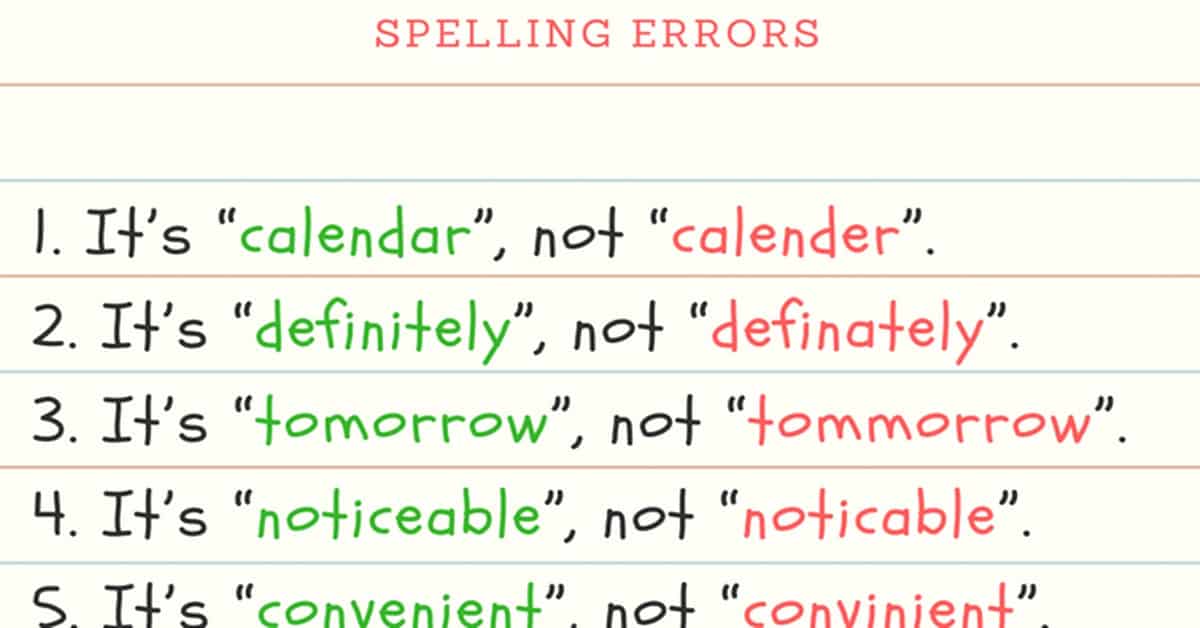
Incorrect: calender
Correct: calendar
Incorrect: definately
Correct: definitely

Incorrect: tommorrow
Correct: tomorrow
Incorrect: noticable
Correct: noticeable
Incorrect: convinient
Correct: convenient
Incorrect: deterioreit
Correct: deteriorate
Incorrect: dissappear
Correct: disappear
Incorrect: arguement
Correct: argument
Incorrect: Wensday
Correct: Wednesday
Incorrect: ignor
Correct: ignore
Incorrect: occured
Correct: occurred
Incorrect: opertunity
Correct: opportunity
Incorrect: que
Correct: queue
Incorrect: speach
Correct: speech
Incorrect: thier
Correct: their
Incorrect: truely
Correct: truly
Incorrect: liesure
Correct: leisure
Incorrect: sieze
Correct: seize
Incorrect: wierd
Correct: weird
Incorrect: intresting
Correct: interesting
Incorrect: knowlege
Correct: knowledge
Incorrect: lollypop
Correct: lollipop
Incorrect: paralell
Correct: parallel
Incorrect: pasttime
Correct: pastime
Incorrect: persue
Correct: pursue
Incorrect: potatoe
Correct: potato
Incorrect: preceeding
Correct: preceding
Incorrect: pronounciation
Correct: pronunciation
Incorrect: recieve
Correct: receive
Incorrect: reccomend
Correct: recommend
Incorrect: rythm
Correct: rhythm
Incorrect: shedule
Correct: schedule
Incorrect: seige
Correct: siege
Incorrect: sentance
Correct: sentence
Incorrect: seperate
Correct: separate
Incorrect: sincerly
Correct: sincerely
Incorrect: tatoo
Correct: tattoo
Incorrect: tendancy
Correct: tendency
Incorrect: untill
Correct: until
Incorrect: vaccuum
Correct: vacuum
Incorrect: vegeterian
Correct: vegetarian
Incorrect: whereever
Correct: wherever
Incorrect: writen
Correct: written
Incorrect: finaly
Correct: finally
Incorrect: fluoroscent
Correct: fluorescent
Incorrect: goverment
Correct: government
Incorrect: grammer
Correct: grammar
Incorrect: happend
Correct: happened
Incorrect: dilemna
Correct: dilemma
Incorrect: existance
Correct: existence
Incorrect: familar
Correct: familiar
Incorrect: foriegn
Correct: foreign
Incorrect: futher
Correct: further
The English language doesn’t always seem completely logical and some spellings aren’t obvious, even to native speakers. These are words that you just have to learn.
This is especially confusing when it comes to words that sound the same but have different meanings. It’s very easy to mix these up when you’re writing them down, but it will cost you a lot of marks in your writing exam.
Let’s look at some of the most common mistakes that English learners make – and how to avoid them.
“It’s” is short for it is. Here, the apostrophe takes the place of the “i”. For example, you would write “it’s very cold outside” (it is very cold outside) or “it’s half past twelve” (it is half past twelve).
“Its” means that the next thing in the sentence belongs to whatever the “it” is. For example, you could say, “the dog dropped its ball” or “the best thing about the iPhone is its camera”. In these sentences, it would not make sense to say “the dog dropped it is ball” or “the best thing about the iPhone is it is camera”.
So, if you are unsure of which to use, replace “it’s”/”its” with “it is”. If it still makes sense, you should use “it’s”. It if doesn’t, use “its”.
“They’re” is the plural version of the “it’s”. It’s short for “they are”. For example: “What time are your friends arriving?” “They’re arriving at 8pm” (They are arriving at 8pm).
“Their” is the plural form of “its”, “hers” or “his”. For example, “The children put on their shoes” or “the lions showed their teeth”.
Finally, “there” refers to a place – to where something is. For example, you could say “I put the book over there” or “The car is parked there”, or “It was there that we saw the fireworks”.
The English language doesn’t always seem completely logical and some spellings aren’t obvious, even to native speakers. These are words that you just have to learn.
This is especially confusing when it comes to words that sound the same but have different meanings. It’s very easy to mix these up when you’re writing them down, but it will cost you a lot of marks in your writing exam.
Let’s look at some of the most common mistakes that English learners make – and how to avoid them.
“It’s” is short for it is. Here, the apostrophe takes the place of the “i”. For example, you would write “it’s very cold outside” (it is very cold outside) or “it’s half past twelve” (it is half past twelve).
“Its” means that the next thing in the sentence belongs to whatever the “it” is. For example, you could say, “the dog dropped its ball” or “the best thing about the iPhone is its camera”. In these sentences, it would not make sense to say “the dog dropped it is ball” or “the best thing about the iPhone is it is camera”.
So, if you are unsure of which to use, replace “it’s”/”its” with “it is”. If it still makes sense, you should use “it’s”. It if doesn’t, use “its”.
“They’re” is the plural version of the “it’s”. It’s short for “they are”. For example: “What time are your friends arriving?” “They’re arriving at 8pm” (They are arriving at 8pm).
“Their” is the plural form of “its”, “hers” or “his”. For example, “The children put on their shoes” or “the lions showed their teeth”.
Finally, “there” refers to a place – to where something is. For example, you could say “I put the book over there” or “The car is parked there”, or “It was there that we saw the fireworks”.


| Present Perfect Simple | Past Simple |
Unfinished actions that started in the past and continue to the present:
|
Finished actions:
|
A finished action in someone's life (when the person is still alive: life experience):
|
A finished action in someone's life (when the person is dead):
|
A finished action with a result in the present:
|
A finished action with no result in the present:
|
With an unfinished time word (this week, this month, today):
|
With a finished time word (last week, last month, yesterday):
|
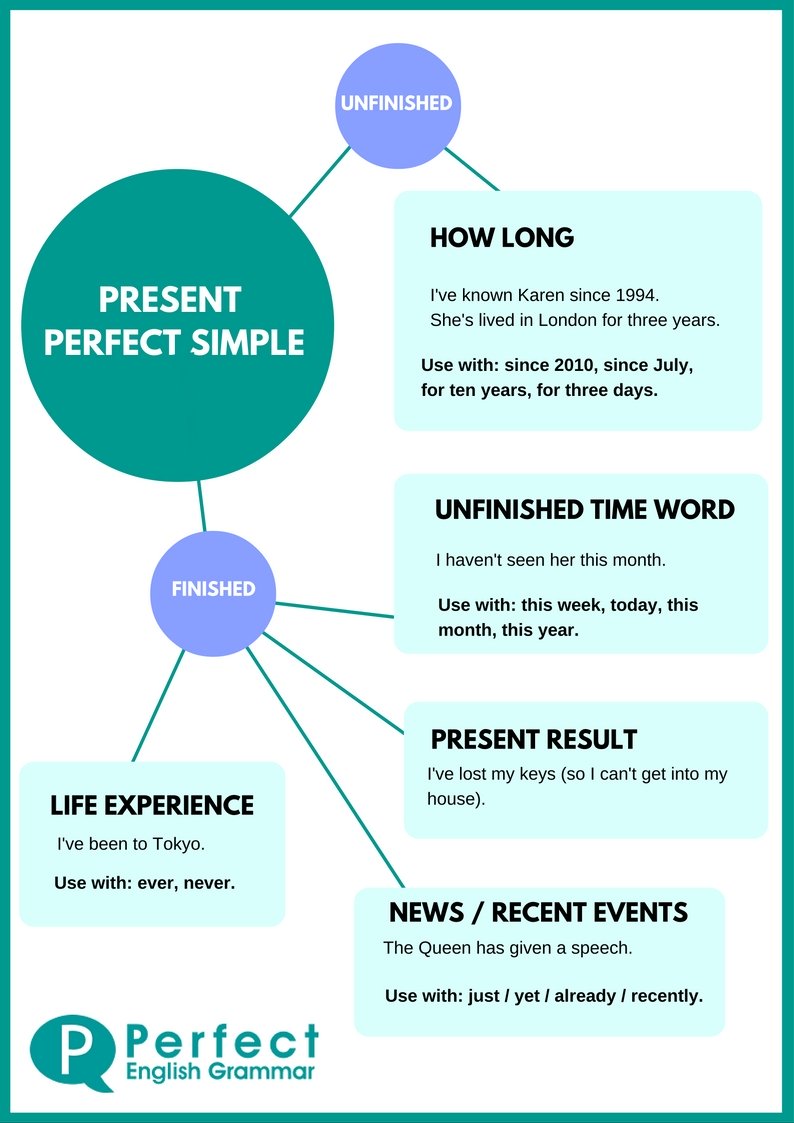
We use this tense for unfinished and finished actions.
Unfinished Actions
1: We
use this tense when we want to talk about unfinished actions or states
or habits that started in the past and continue to the present. Usually we use it to say 'how long' and we need 'since' or 'for'. We often use stative verbs.
'Since' and 'For'
We use
'since' with a fixed time in the past (2004, April 23rd, last year).
The fixed time can be another action, which is in the past simple (since
I was at school, since I arrived).
We use 'for' with a period of time (2 hours, three years, six months).
Finished Actions
2:
Life experience. These are actions or events that happened sometime
during a person's life. We don't say when the experience happened, and
the person needs to be alive now. We often use the words 'ever' and
'never' here.
3: With an unfinished time word (this month, this week, today). The period of time is still continuing.
We CAN'T use the present perfect with a finished time word.
4: A finished action with a result in the present (focus on result). We often use the present perfect to talk about something that happened in the recent past, but that is still true or important now. Sometimes we can use the past simple here, especially in US English.
5: We can also use the present perfect to talk about something that happened recently, even if there isn't a clear result in the present. This is common when we want to introduce news and we often use the words 'just / yet / already / recently'. However, the past simple is also correct in these cases, especially in US English.
Been and Gone
In
this tense, we use both 'been' and 'gone' as the past participle of
'go', but in slightly different circumstances. We use 'been' (often when
we talk about life experience) to mean that the person we're talking
about visited the place and came back.
We use 'gone' (often when we are talking about an action with a result in the present) to mean that the person went to the place and is at the place now.
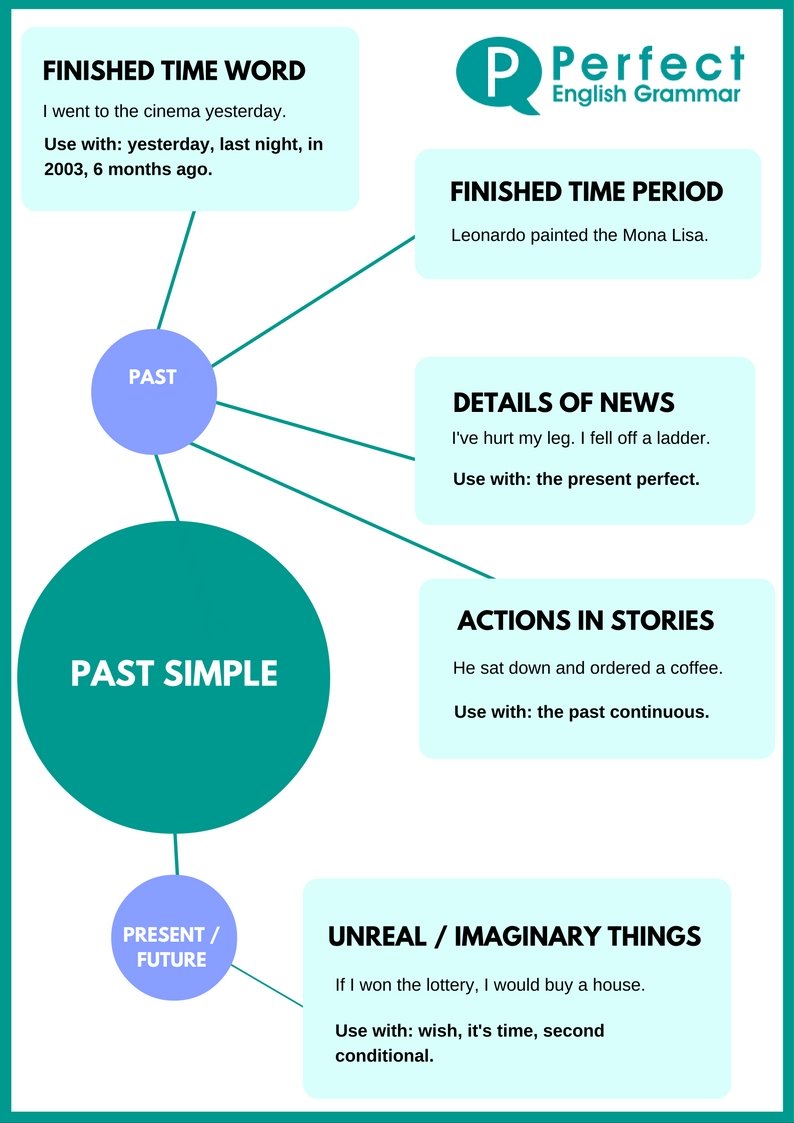
This
is the basic past tense. We use it whenever we want to talk about the
past and we don't have any special situation that means we should use
the past perfect, present perfect or past continuous.
Finished actions, states or habits in the past
1:
We use it with finished actions, states or habits in the past when we
have a finished time word (yesterday, last week, at 2 o'clock, in 2003).
2: We use it with finished actions, states or habits in the past when we know from general knowledge that the time period has finished. This includes when the person we are talking about is dead.
3: We use it with finished actions, states or habits in the past that we have introduced with the present perfect or another tense. This is sometimes called 'details of news'.
4: For stories or lists of events, we often use the past simple for the actions in the story and the past continuous for the background.
Unreal or imaginary things in the present or future
5:
We use the past simple to talk about things that are not real in the
present or future. So we use it with the second conditional and after
words like 'wish'.

Below are the contractions definition and list of commonly used contractions in English.
Contractions definition: We use contractions (I’m, we’re) in everyday speech and informal writing. Contractions, which are sometimes called “short forms”, commonly combine a pronoun or noun and a verb, or a verb and not, in a shorter form. Contractions are usually not appropriate in formal writing.
